Key Takeaways
- Hugging Face's CEO argues China is winning the AI race specifically because of its open-weight strategy, while Fortune has separately asked whether the entire "US vs China" framing has been replaced by an "open vs closed" one — two framings that sound like they're competing but might just be describing different things.
- The US and Chinese AI industries appear to be optimizing for different things: American frontier labs have largely stayed closed and API-gated, while Chinese labs have leaned into distributing full model weights, which means "who's ahead" depends entirely on whether you're measuring proprietary capability or global adoption and distribution.
- Neither strategy is free: open weights are being adopted, modified, and embedded into other products faster and more widely, while closed models remain easier to safety-test end to end and to monetize directly, and any honest answer to "who's winning" has to specify which of those outcomes actually matters before it can mean anything.
Hugging Face's CEO said this week that China is winning the AI race, and the reasoning centers specifically on open-weight models, arriving amid the safety concerns that discussions of open-weight release tend to carry with them. The comments, covered by TimesNow and NDTV Profit, read to us less like a claim that China has built the single best model on the planet and more like a claim about strategy — open distribution as the approach that's actually working. That's a meaningfully different claim than the one usually implied by "winning the AI race," and we think the gap between those two claims is worth pulling apart rather than collapsing into a single headline.
The same week, Fortune ran a piece under a headline that asks the question more directly than most coverage bothers to: "Has the AI race shifted from U.S. vs China to open vs closed?" That's not just a clever rewrite of the same story. It's a proposal that the frame everyone defaults to — two countries, one race, a single finish line — might be the wrong frame, and that the more accurate axis running through the industry right now is a strategic one, open versus closed, that happens to correlate with geography without being defined by it. This is also arriving in the same news window as coverage of how quickly Chinese labs have been shipping new releases, and of a US safety-review framework that, as currently constructed, doesn't apply to open-weight models at all. We're not re-litigating either of those stories here — they deserve their own treatment, and we've given them one elsewhere. What we want to sit with is the framing question itself, because we think it's doing more work, and is less settled, than either headline lets on.
Two Claims That Sound Like the Same Claim
Read quickly, the Hugging Face CEO's comment and the Fortune headline sound like two versions of one underlying fact, restated from different angles — one framed as a geopolitical scoreboard, one framed as a strategic axis. They might be. But "China is winning" and "the real divide is open versus closed" are actually two separable claims, and you can hold one without holding the other. You could believe China's open-weight approach is the smarter long-term bet and still think the US retains an edge on raw frontier capability today. You could believe the open-versus-closed split matters more than national origin and still have no confident answer about who's ahead inside either category. These two framings got bundled together because they surfaced in the same news cycle, not because they're logically the same statement, and we think that bundling is doing some quiet, unexamined work in how this story is being read.
It helps to picture what each scoreboard would actually look like on its own terms. A scoreboard built around frontier benchmark performance would ask which lab's best model scores highest on the hardest evals, updated every time a new flagship ships. A scoreboard built around distribution would ask how many products, research projects, and downstream applications are quietly running on a given lab's weights months after release. Both are legitimate ways to keep score. Neither one is what most people mean when they casually ask who's winning the AI race, because that question usually wants a single number, and these two scoreboards can rank the same two countries in opposite orders at the same time without either one being wrong.
Our Priors on Open vs. Closed Haven't Moved
We've made this argument before about open-weight versus closed models on their own terms, and nothing here changes it: there's no universal answer to which approach is better, and we're skeptical of anyone offering one with total confidence, in either direction. The case for openness — faster iteration, broader outside scrutiny, wider downstream adoption — is real. So is the case for closed, gated deployment — tighter control over misuse, a cleaner line for safety testing, a direct path to monetizing access itself. Both cases are also, partly, after-the-fact justifications for whichever strategy a given lab already landed on for reasons that had more to do with talent, capital structure, and existing business model than with a philosophical conclusion about openness. We don't think "who's winning the AI race" escapes that same trap. It just moves the question up a level, from model to country, and the geopolitical framing tends to make people more confident in their answer, not less, even though nothing about the underlying uncertainty actually went away.
The US and China May Not Be Running the Same Race
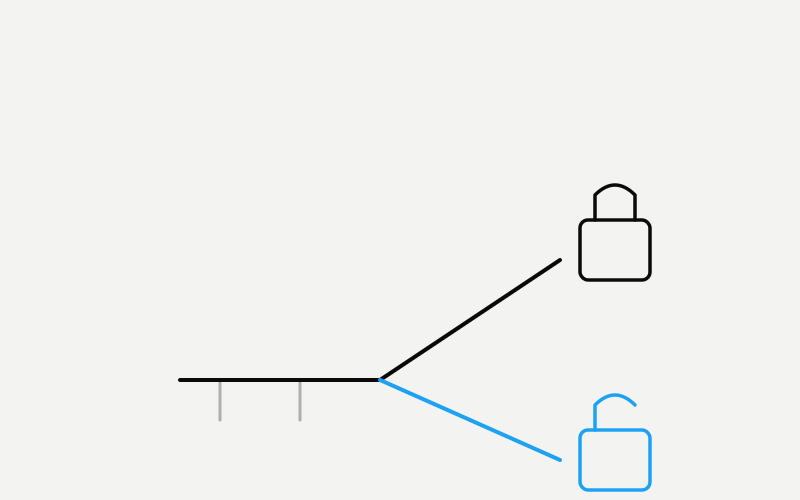
Here's the version of this argument we think is actually useful, rather than a shrug dressed up as nuance. On the pattern of coverage we've seen, American frontier labs have built their competitive strategy overwhelmingly around closed, API-gated flagship models — you get access to the capability, the lab keeps the weights. Chinese labs, per that same coverage, have leaned considerably harder into open-weight releases as a primary way of competing. If that's a roughly accurate description of the two countries' dominant strategies, then asking who's "ahead" quietly assumes both are running toward the same finish line, when they may simply be optimizing for different outcomes entirely. A closed flagship model behind an API is a bet on retaining proprietary capability advantage and controlling exactly how and where the model gets used. A widely released open-weight model is a bet on adoption — on becoming the default component that other people's products get built on top of, in as many places as possible, as fast as possible. Under the first definition of winning, the prize is having the best model nobody else can copy. Under the second, the prize is being the model everyone else's stack quietly depends on. The Hugging Face CEO's framing and Fortune's framing can both be locally accurate descriptions of two different competitions running in parallel, not two conflicting accounts of one race with a single winner.
It's also worth considering, carefully and without overclaiming, why the two countries might have drifted toward different strategies in the first place. A lab's choice between open and closed isn't made in a vacuum — it reflects the capital it has access to, the regulatory environment it operates in, and how it expects to make money from the model in question. None of that is a fact we're asserting about any specific lab's internal reasoning; it's a general pattern worth keeping in mind before treating either country's dominant strategy as a single, unified choice made for one clean reason. Strategies that look coordinated from the outside are often just several separate companies responding to similar incentives.
Different Bets, and the Consequences Are Real Either Way
The tempting next move here is to conclude that the whole "who's winning" question is incoherent and therefore doesn't matter. We don't think that's right, and we want to be careful not to flatten the argument into that shrug. The strategic choice between open and closed carries consequences that are real, asymmetric, and worth naming plainly, even if they never resolve into one shared scoreboard. Open weights get downloaded, fine-tuned, stripped down, and embedded into other companies' and other countries' products at a speed and breadth that a closed, API-gated model structurally can't match — every derivative becomes a new foothold, and that kind of distribution compounds in ways that are hard to claw back later. Closed models, in exchange, are easier to safety-test end to end because the lab controls the entire deployment surface, and easier to monetize directly, because controlled access is itself the product being sold. Neither tradeoff is free, and neither is obviously the correct long-run move. They're different bets on what ends up mattering more over time — being the substrate other people quietly build on, or being the product nobody else can replicate.
What Would Actually Settle This
So: is China winning the AI race? Is the real divide open versus closed rather than country versus country? Our honest answer is that neither question is specified clearly enough yet to be answerable, and we think that's a more useful place to land than it sounds. A genuinely meaningful version of "who's winning" would need to state winning at what — frontier capability on the hardest benchmarks, developer and enterprise adoption, revenue, geopolitical leverage, share of the global open-weight ecosystem — because on the evidence in front of us, the US and China plausibly lead on different items on that list depending on which one you pick. Until a claim specifies which axis it means, "winning" is carrying a lot of unexamined weight for a word that sounds far more precise than it is. We don't have that specification to hand you, and we're not going to manufacture one just to end this piece on a tidier note than the evidence supports. What we'll be watching for instead is whether the coverage that follows this week starts getting more specific about what it's actually measuring, or just keeps reaching for the scoreboard because it's the easier story to tell.
A few concrete things would move us off the fence here, if we saw them. If a major US lab released a genuine flagship model's weights, rather than just smaller or older ones, that would suggest openness is viable at the frontier and not just a fallback for labs that can't compete on proprietary capability. If a leading Chinese lab pivoted its best model to a closed, monetized API instead of an open release, that would suggest the open strategy is more circumstantial than structural. And if coverage of either country's AI industry started reporting adoption and deployment figures with the same seriousness it currently reserves for benchmark scores, that alone would tell us the industry was finally measuring the thing it claims to care about.