Key Takeaways
- Two separate reports describe Anthropic CEO Dario Amodei worrying that engineers are joining the company "just for the money" rather than its mission, and, separately, referring to disloyal staff as "untrustworthy rats." We read these as two expressions of one underlying tension rather than unrelated remarks, because the money-chasing worry looks like the more presentable version of the same anxiety that produced the sharper insult.
- This isn't a problem unique to Anthropic or to Amodei's temperament — it's the predictable bind facing any originally mission-driven company once it has to pay competitively in a market where compensation at every frontier lab has become extraordinary, since it can't opt out of market-rate pay without losing the engineers its mission depends on. Anthropic is simply the lab where the friction is currently visible, largely because its brand leans on mission-first framing more heavily than most of its competitors do.
- The more revealing half of this story is the size of the gap between the two comments, not either one alone: worrying about money-motivated hires is an ordinary, almost sympathetic founder concern, while publicly reported language like "untrustworthy rats" is a sharper, more personally charged reaction, and that gap is informative about internal strain even though we don't know what specifically triggered the harsher remark. What would actually confirm a real pattern is attrition data and whether other mission-branded labs start voicing the same tension out loud, not the quotes themselves.
Two pieces of coverage about Anthropic CEO Dario Amodei landed around the same time, and taken separately, they read like two different stories about two different moods. One, reported by India Today citing an earlier report, describes Amodei as worried that engineers are joining Anthropic "just for the money" rather than because they believe in the company's mission. The other is sharper: GEO TV reported Amodei lashing out at his own company's employees, referring to disloyal staff as "untrustworthy rats." The Next Web rolled the broader theme into a piece framed around "AI Talent Wars: Loyalty, Money, Mission" — and that framing, we think, is the right place to start, because these two comments make more sense read together than apart.
We want to be upfront about what we don't have here. We don't have a transcript or the full context behind either comment, we don't know what specifically prompted the "rats" language, and we don't know whether it came up in the same conversation as the money-chasing concern or somewhere else entirely. What we do have is two data points from the same person, in the same rough window of coverage, circling the same underlying anxiety — that some share of the people building Anthropic's models might not be there for the reason the company's public identity has spent years insisting they're there for. That's worth taking seriously as a structural question before it gets treated as a personality one.
Two Quotes, One Underlying Question
Start with the more ordinary of the two comments, because it's easy to skip past on the way to the more quotable one. Worrying that new hires are motivated by compensation rather than mission is, frankly, a concern almost any founder of a values-driven company could plausibly voice in a private moment, and voicing it isn't itself alarming. Every organization that grows past a certain size ends up hiring people who are good at the job and less personally invested in the founding story than the people who joined first. That's not a scandal — it's closer to an operating constant of scale, and on its own it would barely be news.
The second comment is a different register entirely. "Untrustworthy rats" isn't a description of a hiring trend — it's a judgment about specific people, in language built to wound rather than diagnose. Set the two comments side by side and they describe the same underlying worry moving from analysis to accusation. We don't think that shift is incidental to the story here. We think it might be the actual story, and the money-chasing concern is really just the more presentable half of the same underlying unease.
The Bind That Comes With a Mission-First Brand
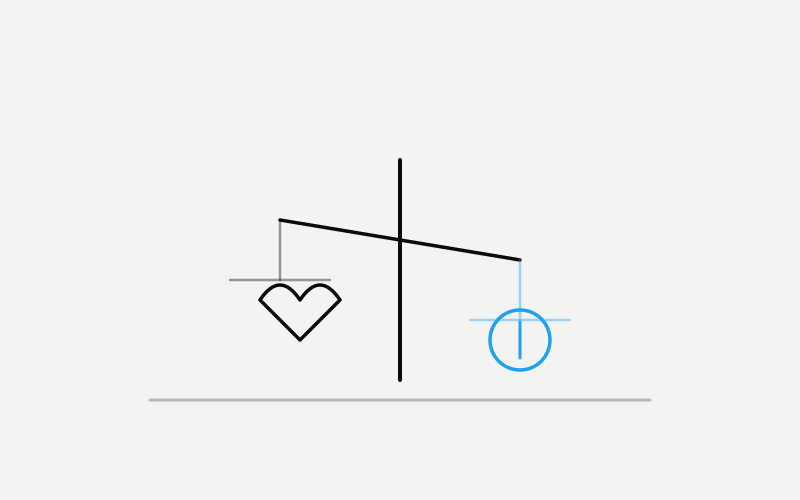
Here's the structural read we'd offer, and it's bigger than one CEO's choice of words. Anthropic has spent years building a public identity around a mission-first, safety-first origin story — a company that, per its own framing, exists because building this technology carefully matters as much as building it fast. That framing has been genuinely useful to Anthropic: it functions as a recruiting pitch, a press narrative, and arguably a real operating philosophy, all at once. But it also sets a trap that a purely commercially-branded competitor never has to worry about walking into.
The trap is this: once compensation at every frontier lab becomes extraordinary, a mission-first company still has to pay competitively or lose the engineers who make its mission possible to build in the first place. It can't opt out of the market rate just because its founding story is about something other than the market rate. So it ends up competing on pay exactly like every other lab, while carrying a public narrative that implies it's motivated by something other than pay — and that gap between narrative and market reality was always going to produce friction somewhere. This is what we mean when we say this isn't a uniquely Anthropic problem. It's what happens to any originally mission-driven organization once it has to compete on total compensation with organizations that never made the same promise about why people should join in the first place. That's also a harder needle to thread than it first sounds, because the same competitive pay that keeps an engineer from leaving for a rival lab is also the exact thing that can make leadership start wondering why that engineer joined in the first place.
The Real Signal Is in the Gap Between the Two Comments
So why is Anthropic the company where this is surfacing loudly enough to make headlines, rather than some other lab quietly having the identical internal conversation? Our read is that it's precisely because Anthropic's brand leans so heavily on the mission framing to begin with. A lab that has never centered its public identity on loyalty or purpose over compensation doesn't generate a headline when it turns out some of its engineers are there for the paycheck — that's just assumed going in. Anthropic generates a headline because the gap between its stated identity and this specific admission is larger — and larger gaps are more newsworthy by definition. The mission narrative is the thing that turns an ordinary labor-market fact into a story.
That also explains why "untrustworthy rats" lands so much harder than it otherwise would. Coming from a CEO whose company never claimed to be building something bigger than a paycheck, sharp language about disloyal staff would just be normal founder venting — the kind that happens everywhere and rarely travels past the room it was said in. Coming from the CEO of a company whose public case for itself rests partly on being mission-driven rather than money-driven, the same words carry more weight, because they suggest the mission framing is under more internal strain than the outward story lets on. We'd stop short of reading Amodei's state of mind into that — we don't have the context for what specifically triggered the comment, and we're not going to guess at a precipitating event we weren't given. But the size of the gap between a measured worry about incentives and a public insult aimed at disloyal staff is, on its own, informative about how much this tension is costing internally — independent of whatever the trigger turns out to be.
Maybe We're Reading Too Much Into Two Quotes
We should stress-test our own framing here, because it's possible we're doing exactly what we'd criticize other coverage for doing: taking two quotes and building a tidier narrative out of them than the underlying reality supports. It's entirely possible these are two separate remarks — made at separate times, about separate situations — that happen to share a general theme and got packaged together by outlets chasing a talent-wars story. Founders say sharp things about employees sometimes without it reflecting any deep structural crisis. Plenty of leaders across plenty of industries have said something in a moment of frustration that reads far more significant in a headline than it felt in the room where it was actually said. Venting isn't evidence of a company-wide loyalty problem, and one pointed phrase doesn't automatically generalize to how Amodei thinks about his workforce as a whole.
Still, we don't think that possibility fully dissolves the more interesting question, which is why these two particular remarks — out of everything a CEO says in a given stretch — are the ones that got reported and packaged this way. Even in the more boring version of this story, where the comments are unrelated and we're overreading them along with everyone else, the fact that both are plausible enough to report says something about how expected this kind of friction has become inside frontier labs right now. Outlets don't need much of a nudge to run a loyalty-versus-money framing at the moment, and that alone tells us the underlying tension is already assumed to be real, whether or not this specific pair of quotes proves it.
What Would Actually Tell Us More
What would move this from a two-quote story to an actual pattern worth tracking is more mundane than either comment — whether Anthropic's hiring and attrition numbers over the coming months look different from its peers', whether Amodei or the company address the "rats" language on the record rather than leaving it to stand as reported, and whether other leaders at similarly mission-branded labs start voicing versions of the same concern in public rather than only in private. Right now we have language, not data, and language is the easier of the two to overread. A single strongly worded phrase, however striking, isn't the same kind of evidence as a quarter of exit interviews, and we'd weight the two very differently once more information actually becomes available.
The broader dynamic underneath all of this isn't going away, regardless of how this particular story resolves. As long as compensation packages keep escalating across every frontier lab, any company whose public identity was built on being motivated by something other than compensation is going to keep having some version of this argument with itself — out loud or not. Anthropic just happens to be the lab where it's currently visible. We'd expect other labs with similar origin stories to hit some version of the same friction as the market keeps pushing pay upward, and we'd treat this less as a verdict on Anthropic specifically than as an early, fairly legible preview of a tension the rest of the industry hasn't had to publicly confront yet. The specific words a CEO reaches for in a moment of frustration will always be more visible than the compensation spreadsheets driving the underlying pressure, but it's the spreadsheets that actually explain why the words showed up when they did.