Key Takeaways
- A context window is recomputed from scratch on every call with no persistent state, so anything not resent as text effectively does not exist to the model.
- A bigger context window increases cost and can degrade reliability, since information buried in the middle of very long context is used less consistently than information near the edges.
- Real memory is engineered from three separate building blocks: retrieval that loads only relevant stored information, summarization that compresses history, and structured external state for facts that must never be lost.
Context windows have gotten enormous, and somewhere along the way a lot of smart people started treating "big context window" and "the system remembers things" as roughly the same claim. They are not the same claim, and the gap between them is exactly where a surprising number of otherwise well-built AI products quietly fail their users — the assistant that "forgets" a preference from last week, the agent that re-asks a question you already answered, the system that clearly has no idea what happened in a conversation from yesterday even though it handled that exact conversation perfectly well at the time.
At GLSRM we think this confusion is worth clearing up precisely because it's an architecture mistake dressed up as a model limitation. The model isn't failing to remember. Nobody built it a way to.
What a context window actually is
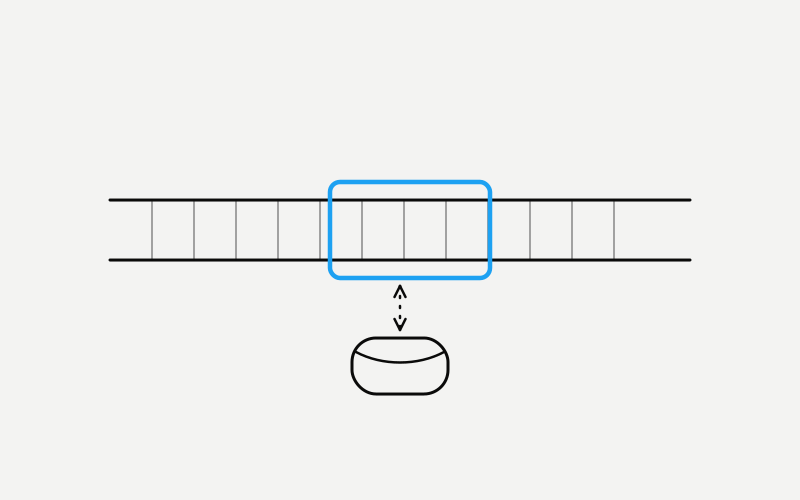
A context window is the text the model reads in order to generate its next response — nothing more, nothing less. It is recomputed from scratch on every single call. There is no persistent state living inside the model between requests, no internal notebook it's quietly updating, no sense in which information sinks in the way it does for a person having a conversation over several days. If a fact isn't in the text you send this time, as far as the model is concerned, that fact does not exist right now, no matter how many times it appeared in previous calls you made yesterday.
This is easy to say and genuinely counterintuitive to internalize, because a long, fluid conversation feels continuous from the user's side. It isn't continuous underneath. Every single turn, the entire visible history — or as much of it as your system chooses to include — gets resent as plain text, and the model reprocesses all of it as though seeing it for the first time, because functionally, it is. The window is a scratchpad the size of however many tokens your product includes in the request, wiped clean and rebuilt every single call. Calling that memory is a category error, the same kind of error as calling working memory a filing cabinet because both of them, in the moment, hold information a person can access.
Play this forward and the implication is stark: if a product's only mechanism for continuity is including the whole prior conversation in the next request, then the moment that conversation gets truncated, summarized away, or simply ends because the user closed the tab, whatever wasn't otherwise saved is gone, permanently, with no more trace than a thought nobody wrote down. That's not a bug in the model. It's the direct and entirely predictable consequence of never having built anything for information to live in beyond the request currently in flight.
'Just use a bigger context window' is not a memory strategy
The industry-wide trend toward much larger context windows is genuinely useful for a lot of things — long documents, big codebases, multi-file reasoning in a single pass. It is not, by itself, a solution to the memory problem, and treating it as one leads teams toward an expensive and fragile pattern: stuff the entire conversation history, forever, into every single call, and call that "memory" because the window is technically big enough to hold it.
Two problems show up fast. The first is cost — every token in that growing history gets paid for, and reprocessed, on every single turn, so a system with genuine long-term users accumulates a cost curve that grows without bound if nothing is ever pruned or compressed. The second is subtler and matters more: models don't attend to every part of a very long context equally well, and information buried in the middle of a huge block of text is well documented, across the industry, to get used less reliably than information near the beginning or end. A bigger window doesn't just cost more. Past a certain point, it can make the model's actual use of your carefully preserved history worse, not better, which is close to the opposite of what teams reaching for "just make the window bigger" are hoping to buy.
Real memory, part one: retrieval
The first real building block of memory is retrieval — storing information somewhere outside the model's context window, in a database, a search index, or a vector store, and pulling only the relevant pieces into context when they're actually needed for the current turn, rather than carrying everything all the time. A support agent doesn't need a customer's entire eighteen-month history sitting in every single conversation. It needs the two or three past interactions actually relevant to the current issue, fetched at the moment they're useful and left out otherwise.
This is a genuinely different architecture from "bigger window," because it separates what's stored from what's loaded. Storage can grow indefinitely and cheaply, because it isn't being reprocessed by the model on every call. Only the retrieved slice — small, relevant, chosen deliberately for this specific turn — actually enters the context window and costs tokens. Done well, this is most of what people actually mean when they say an AI product remembers them, and it has essentially nothing to do with how large the underlying model's context window happens to be.
The retrieval step itself can be as simple as a keyword search against stored notes or as involved as an embedding-based similarity search across a large archive of past interactions; the mechanism matters less than the underlying discipline of treating what's stored and what's loaded into this particular request as two separate decisions. A system that gets this right can, in principle, hold an unbounded amount of information about a user while sending the model only a few hundred tokens of it on any given turn — the opposite of the all-or-nothing instinct that treats the context window itself as the storage layer.
Real memory, part two: summarization and compaction
The second building block handles information that's less about specific facts to retrieve and more about accumulated context that needs to persist in compressed form — the gist of a long conversation, the state of an ongoing project, the shape of a relationship with a user over time. Rather than keeping the raw transcript forever, a system periodically compresses it: a rolling summary that gets updated as new information comes in, older detail gradually collapsing into broader strokes while recent detail stays sharp.
This mirrors, loosely, how human memory itself works. Nobody recalls a conversation from six months ago as a verbatim transcript; they recall its shape and its important specifics, with the texture faded out. Building this deliberately, rather than hoping a huge context window will somehow do the same job by brute force, is what lets a system maintain useful continuity over genuinely long timeframes without the cost curve of carrying every raw token forward forever.
Real memory, part three: external state that isn't text at all
The third building block is the one people most often skip, because it's the least glamorous: explicit, structured state, stored the way any ordinary application stores state — a user's stated preference in a database field, an order's status as a value, a project's current stage as an enum, not as a sentence buried somewhere in a chat log that the model has to correctly re-infer every time. If a preference matters enough that you never want the system to lose track of it, the right answer is usually not "make sure it's somewhere in the context history." It's "store it as data, and inject it explicitly into context when relevant," the same way any well-built application separates its durable state from its transient display logic.
This is the building block that most clearly reveals the underlying confusion, because it requires treating the language model as a component that reads and writes state through your system, rather than as the place the state lives. The model doesn't hold the user's preference. Your database does. The model just gets told about it, on the turns where it matters, the same way any other piece of software gets handed the inputs it needs to do its job.
Picture a scheduling assistant that a user once mentioned, in passing, mid-conversation, that they never take calls before ten in the morning. If that preference exists only as a sentence somewhere in a chat transcript, the system's ability to honor it later depends entirely on that specific sentence still being present in whatever gets sent to the model on some future turn — fragile, unpredictable, and exactly the kind of thing that quietly stops working the moment the conversation history gets pruned or summarized. If instead that preference gets written, the moment it's stated, into a structured record the scheduling logic actually checks against every time it proposes a time, it survives indefinitely, independent of anything happening in any particular context window.
The mistake this confusion actually causes
Teams that conflate context windows with memory tend to make one of two opposite errors we see again and again, and both come from the same root misunderstanding. Some under-invest, assuming a generous context window means memory is already handled, and end up shipping a product that feels amnesiac the moment a session ends or a conversation gets long enough to need pruning, because nothing was ever actually stored anywhere durable. Others over-invest in exactly the wrong direction, building elaborate systems to cram ever more raw history into ever-larger context windows, paying escalating token costs for a system that performs worse, not better, as the history grows, because they never separated storage from retrieval in the first place.
The fix for both is the same: stop asking how big the window needs to be, and start asking what actually needs to persist, in what form, and how it gets back into context at the moment it's needed. That's a systems design question with a genuine engineering answer — retrieval, summarization, structured external state, chosen and combined deliberately for what your product actually needs to remember. A context window was never going to answer that question for you, no matter how large it eventually gets.