Key Takeaways
- We treat news, models, releases, benchmarks, agents, and research as one connected beat, because a benchmark score or a launch means little without the context the other beats provide.
- Being fast matters, but we keep 'reporting what happened' and 'assessing what it means' as two distinct steps, so speed never quietly substitutes for verification.
- We weight quiet signals, like methodology changes, roadmap-versus-shipping gaps, and research resurfacing in products months later, more heavily than raw launch-day volume.
Most AI coverage picks a lane and stays in it. Some outlets cover research papers and treat the products built on top of them as somebody else's beat. Some cover product launches breathlessly, quoting the announcement back at you with more enthusiasm than analysis, and treat the underlying research as background trivia nobody needs explained. Some exist mainly to summarize press releases faster than the next outlet can, which is a genuinely difficult operational skill, and also not the same thing as explaining anything to anyone. We built GLSRM because none of those lanes, on their own, actually described the industry we were watching every day.
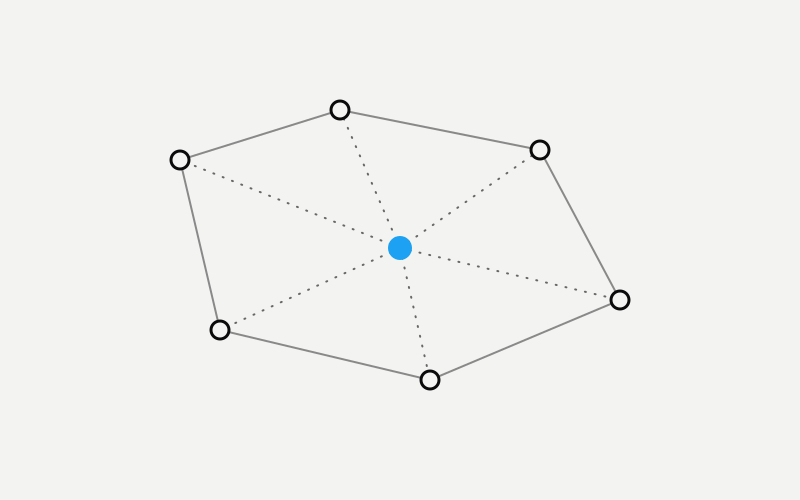
The AI industry isn't five separate beats that happen to share a name. It's one system, where a research direction quietly becomes a shipped product feature eighteen months later, where a benchmark claim means close to nothing until you know exactly what model produced it and under what conditions, and where a new model release is mostly noise until you see what actually gets built on top of it in the weeks after. We think the connective tissue between those things is the real story, more often than any single node in that network is by itself, and that belief shaped almost every structural decision in how we built this.
The Industry Doesn't Sort Itself Into Beats, So We Don't Either
A benchmark result reported without the model, the exact conditions, and the methodology behind it is close to meaningless on its own. A number by itself doesn't tell you what changed, why it changed, or whether it will hold up outside the conditions it was measured under. A model release reported without any sense of how it actually performs, and what gets built on top of it in the following weeks, is a press release wearing the clothes of a news story. A research paper covered in isolation, with nobody tracking whether its ideas resurface in a shipped product months later, misses the part that actually matters most to a reader trying to decide what deserves their attention now versus what's still speculative.
Treating news, models, releases, benchmarks, agents, and research as five separate beats, which is still how a lot of coverage is organized, often because that's how a newsroom happens to be staffed rather than because it reflects how the industry actually moves, loses exactly the connections that make any single one of those categories legible on its own. Our structural bet is that the real story lives in those connections far more often than it lives in any single category, and that a platform organized around tracking the whole stack together, continuously, tells you something a collection of separately staffed beats is structurally incapable of telling you, no matter how good any individual beat reporter is.
Speed Without Turning Into a Rumor Mill
Stale coverage of a fast-moving industry is close to worthless. A two-week-old take on a release cycle that moves in days reads like ancient history by the time anyone reads it, and we take that seriously enough that it shapes how we're built, not just how we write. But speed pursued without discipline turns into something we've actively chosen not to be: repeating an unverified claim because it's exciting to be first with it, treating a company's own announcement as the complete and final account of what happened, or quietly letting "this was announced" blur into "this is as good as it's being described."
We try to hold those two moves apart deliberately, as separate steps rather than one motion. Reporting that something happened, a release shipped, an announcement went out, a paper was published, is fast, and it should be, because there's genuinely low risk in accurately describing an event that occurred; the facts of what was announced are usually not in dispute. Assessing what it actually means, how it performs under real use, and whether the claims attached to it hold up against a track record is a necessarily slower move, because it requires actually checking claims rather than relaying them. Collapsing those two into a single motion is how coverage quietly turns into an amplification engine for whoever has the best launch-day marketing team, regardless of what actually shipped, and we'd rather be a step behind the fastest possible headline than be first with something we haven't actually verified.
What We're Actually Watching For
We pay closer attention to a handful of quieter signals than to raw announcement volume, because volume is cheap to generate and correlates surprisingly poorly with what actually turns out to matter a year later. A quiet change in benchmark methodology often tells us more about competitive positioning than the headline score does; when the way something gets measured shifts right around the time the resulting numbers get more favorable, that's worth noticing and saying plainly, rather than repeating the improved number uncritically as if methodology never changed. We track when the word "agent" starts getting used more loosely than the underlying capability actually supports, because term drift like that is usually an early sign that marketing has outrun the engineering behind it, and naming that gap directly is more useful to a reader than adopting whatever definition happens to be convenient for whoever's selling something this month.
We also watch whether a lab's stated roadmap and its actual shipping pattern are converging or diverging across successive cycles, because that gap, tracked over time rather than judged from any single announcement, is one of the more reliable predictors of how much weight to put on the next roadmap claim from the same source. And we watch research directions that quietly resurface in shipped products months after the original paper; that lag is frequently where the real signal lives, well before it's obvious to anyone only watching launch announcements as they happen. None of these signals produce a dramatic headline on the day we notice them. That's roughly the point.
Being Useful to Practitioners, Not Just Interesting to Spectators
We write for someone who has to act on what they read: decide which model to build on, which vendor's claims to actually trust, which benchmark result deserves real engineering time before it's taken at face value. We are not writing primarily for someone scrolling for entertainment, and that distinction changes what "good coverage" means in a way that's easy to state and considerably harder to hold to once there's pressure to chase attention instead of accuracy.
Coverage optimized for engagement rewards the most dramatic framing available for any given story, because drama travels further and faster than nuance does. Coverage optimized for usefulness rewards being right, being specific about uncertainty where genuine uncertainty exists, and being willing to say something is unclear rather than picking whichever interpretation is more shareable. Those two incentives point in different directions more often than either side of that tension likes to admit, especially under the pressure of a fast news cycle where the dramatic version is always sitting right there, cheaper to write and easier to read. We'd rather build the kind of trust that survives a practitioner checking our work six months later against how things actually played out, than the kind that only needs to survive a single scroll past a headline.
Where We Know We Can Get It Wrong
We don't think honesty about this belongs in a disclaimer buried at the bottom of a page. It belongs in the mission itself. Covering a fast-moving industry means we will sometimes get fooled by a cherry-picked benchmark result presented without its less flattering context, because the flattering framing is usually the one that reaches us first. We will sometimes mistake an impressive demo for a capability that's actually shipped and reliable in the hands of an ordinary user, because the gap between "we showed this working once, under controlled conditions" and "this works, generally, for people who aren't the team that built it" is exactly the gap a good demo is designed to paper over. We will sometimes underweight a quiet piece of research that turns out, in hindsight, to have mattered more than whatever loud launch was dominating attention that same week, because loud is easier to notice than important.
We don't think there's a clever process that eliminates all of that risk; the industry moves faster than any verification process can fully keep pace with, for everyone covering it, not just us. What we can actually do is stay honest about the difference between what we've verified and what we're still watching, correct plainly and visibly when we get something wrong instead of quietly editing it away and hoping nobody noticed the original version, and keep treating "we don't know yet" as a genuinely acceptable thing to publish, rather than a gap we feel pressure to paper over with false confidence.
We're building this on a fairly simple bet: that the AI industry's real story is a connected system, not a pile of disconnected headlines, and that a publication willing to treat it that way, consistently, without cutting corners on the boring parts, over years rather than news cycles, ends up more useful to the people who actually have to make decisions based on what they read than any single fast take ever will be. That's a slower way to build trust than chasing the day's most shareable story. We think it's the only way that actually holds up once someone checks your work, which is the only kind of trust worth having in the first place.