Key Takeaways
- Missing hyperparameters, undisclosed data curation, and unreported evaluation harnesses can each shift a result more than the improvement a paper claims to have found.
- Verifying frontier-scale claims often requires compute only a handful of labs can afford, turning reproduction into an economic privilege rather than a routine check.
- Researchers get little professional credit for replication work, so negative or inconclusive replication attempts rarely get published at all.
In most sciences, a reproducibility crisis gets a name, a task force, and a public reckoning. Psychology has spent the better part of a decade publicly wrestling with how many of its classic findings quietly fail to replicate, and the field is arguably healthier for having done it in the open. Machine learning has, by most honest accounts, at least as large a reproducibility problem, and almost nobody outside the field talks about it as a crisis at all, because the failure mode doesn't look like scandal. It looks like a paper you personally can't get to run the way the authors described, and you quietly assume the fault is yours.
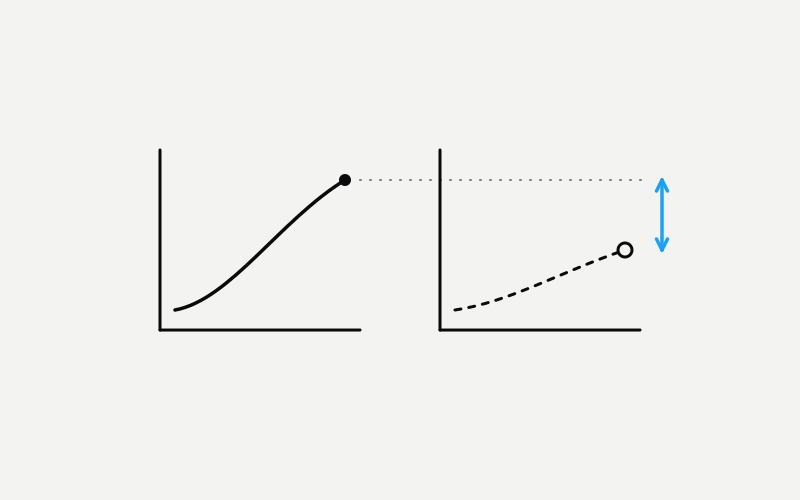
That's the quiet part, and it's doing a lot of work. Nobody writes a viral thread titled "we tried to reproduce this and landed six points lower," because reproduction attempts rarely get funded, rarely get published on their own merits, and when they do surface it's usually as a passing footnote in someone else's related-work section rather than a finding treated with the weight it deserves. The result is a published literature that looks considerably more settled than it actually is, held together as much by the field declining to check as by anything underneath actually holding.
Irreproducible Is Not the Same Claim As Wrong
It's worth separating two very different problems before going further, because collapsing them makes the whole conversation less useful. A result being wrong means the core claim doesn't hold up under any honest attempt to test it. A result being irreproducible means something narrower and more common: you can't tell whether it holds, because you can't recreate the conditions under which it was originally measured. Most irreproducible results in AI research are not fraud. They're the accumulated effect of dozens of small, individually reasonable omissions, plus genuine stochasticity in training, plus tuning decisions nobody thought to write down because they didn't seem like the interesting part of the story.
That distinction cuts in two directions at once. Treating every irreproducible result as a lie is unfair to researchers who did the work honestly and simply didn't anticipate how many details someone else would need. But treating every irreproducible result as trustworthy by default, on the theory that surely nobody would publish something untrue, is worse, because it grants exactly the benefit of the doubt that an unverified claim hasn't earned yet.
The Quiet Ways a Result Stops Being Checkable
Missing hyperparameters are the most common culprit and the least dramatic. Learning rate schedules, warmup length, batch size, which exact checkpoint of a base model got fine-tuned, the random seed, the decoding temperature at evaluation time — any single one of these, left unspecified, can move a result by more than the improvement the paper is claiming to have found. None of it gets omitted out of malice. Papers have page limits, authors run dozens of configurations before settling on the one that shipped, and the specific setting that turned out to matter most is rarely obvious until someone else fails to reproduce it without that detail.
Undisclosed data curation is the harder problem, because it's often genuinely difficult for even the original authors to fully audit. Filtering thresholds, deduplication choices, what got excluded and why, and whether there's any overlap between training data and the evaluation set are all decisions baked into a dataset long before the headline experiment runs, and web-scale data pipelines make a complete accounting of what's actually in the mix a serious undertaking even for the people who built it. A result trained on a data mixture nobody outside the lab can fully see is a result nobody outside the lab can fully verify, regardless of how carefully the method section is written.
And then there's compute. A growing share of the field's most cited results are reported at a scale, in parameters, in training tokens, in cluster size, that an independent academic lab or a smaller company simply cannot afford to attempt. That turns verification from an inconvenience into an economic filter. It's not that nobody wants to check. It's that checking requires a budget most of the people qualified to do the checking don't have.
A fourth cause gets less attention than the other three but distorts just as many comparisons: the evaluation harness itself. Which few-shot examples get shown before the question, how strictly a free-text answer gets parsed, whether the model is prompted to reason step by step first — none of that is part of the model, but all of it is part of the number, and two teams running what they'd both describe as "the same benchmark" can land on meaningfully different scores while both reporting in good faith. A paper that doesn't publish its exact evaluation code alongside its exact model weights hasn't published a reproducible number. It's published a number that happened, once, inside a specific harness nobody else can fully see.
Nobody Gets Credit for Checking Somebody Else's Work
Set the technical barriers aside for a moment and look at the incentives, because they explain why so few people even try. Careers in this field are built on novel contributions, not on confirming what someone else already published. A successful replication isn't news in any venue that matters for tenure, hiring, or a next funding round. A failed replication is worse than unrewarded — it invites a direct conflict with the original authors, who may sit on the review committee for your next submission, and it comes with none of the excitement that drew people into the field in the first place. Confirming old work quietly loses to discovering new work in every incentive system currently operating in AI research, academic or industrial.
Industry labs add a second layer on top of the academic one. A company with a commercial edge tied to exactly how a result was produced has a real incentive not to disclose the full recipe, whatever gets published in the paper. That's not necessarily bad faith — protecting a genuine advantage is a normal business instinct — but it means the competitive-secrecy motive stacks directly on top of the academic career incentive, and both point the same direction: toward publishing the result and away from making it fully checkable.
There's also a simple file-drawer effect at work. A team that spends real time and compute attempting to reproduce a well-known result, and gets a materially different number, then faces an uncomfortable set of options for what to do with that finding: publish something that reads as an accusation against a specific group of authors, quietly shelve months of work, or fold the negative result into the related-work section of an unrelated paper where almost nobody will notice it. Given those options, most teams pick one of the last two, which means the negative replications that do exist are systematically underrepresented in what the field actually reads, even relative to how rarely they're attempted in the first place.
When Verification Requires a Data Center
The compute barrier deserves its own emphasis, because it changes who is even structurally capable of checking a claim. At frontier scale, "just rerun it and see" is not a sentence that means anything for a team without access to enormous compute budgets. That creates a genuinely strange situation: the only organizations capable of verifying a frontier lab's biggest claims are other frontier labs, and those labs have every competitive reason not to spend their own compute publicly checking a rival's homework, and even less reason to publish the results if a check happens to come back unfavorable.
Everyone else is left verifying claims at a smaller scale and hoping the finding holds as it scales up, which is exactly the assumption that the field's own scaling-law research says you shouldn't make automatically. Behavior that looks stable at one order of magnitude can shift, sometimes sharply, at the next one. A result nobody outside a handful of labs can afford to check at the scale it was reported isn't necessarily wrong. It's just operating on trust in a field that talks constantly about rigor.
This Is Not Academic Housekeeping
It's tempting to file all of this under inside-baseball concerns for people who care about scientific purity, but the consequences land squarely on anyone making real decisions off published claims. A technique that looked like it generalized in the paper, but was quietly tuned to a specific benchmark or a specific data mixture that never got fully disclosed, can waste months of an engineering team's time when it fails to transfer to a slightly different setting. A capability that seemed proven at the scale it was published can turn out to have been a fragile artifact of that particular scale, not a floor the field can safely build on. Strategy decisions, hiring plans, and investment theses get built on the assumption that a published result is a stable foundation, when it may really be closer to an anecdote that nobody has gotten around to stress-testing yet.
None of this means AI research is fabricated or that most published results are false. Most researchers are doing careful, honest work under real constraints of time, page limits, and compute budgets. But until the field builds actual incentives to check work rather than just publish it, every reader — us included — is implicitly extending more trust to a single unreplicated result than the word "peer reviewed" or "published" really earns on its own. The right response isn't cynicism about the whole enterprise. It's holding any single paper's claim a little more loosely until something independent confirms it, and noticing how rarely that confirmation actually arrives.