Key Takeaways
- A paper's headline result is often the best run out of many under controlled conditions, while a shipped product must handle messy real input reliably at scale.
- The unglamorous engineering for guardrails, fallback logic, and monitoring around a technique's failure cases is often larger than the technique itself, and it rarely appears in a paper.
- Research and product teams are typically rewarded by opposite incentive structures, novelty and publication versus uptime and reliability, so promising work often has no one accountable for shipping it.
Picture a paper that reports a genuinely good result: a technique that measurably improves accuracy on a hard task, published with real numbers, honest ablations, and code that actually runs when you clone it. Eighteen months later it has three hundred citations and has shipped in approximately nothing. This isn't a rare pattern. It's close to the default outcome for published research, and it has almost nothing to do with the technique being wrong.
The gap between a working paper and a shipped feature is one of the least discussed parts of the AI industry, mostly because neither side finds it flattering to talk about. Researchers don't love dwelling on how much of their published work never leaves the paper. Product teams don't love admitting how much promising research they've quietly read, admired, and shelved. Here's what's actually happening in that gap, because understanding it changes how you should read a promising result in the first place.
A Demo Is One Great Run. A Product Is a Million Ordinary Ones.
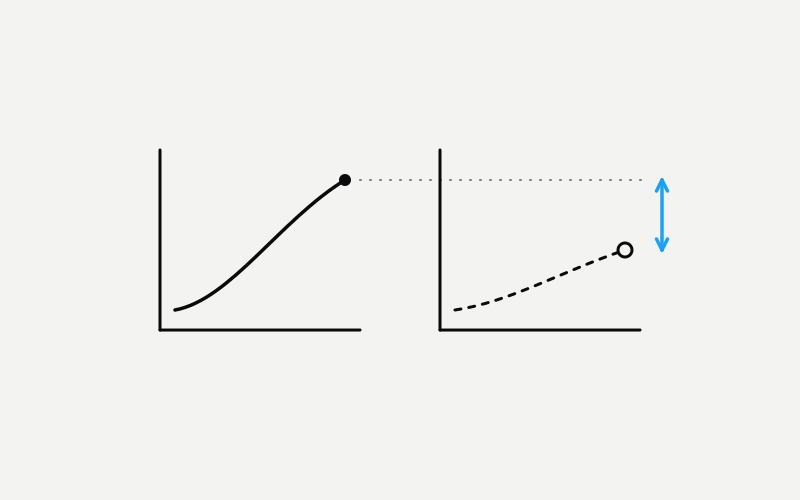
A paper's headline result is often close to the best run out of many attempts, evaluated on a test set the authors chose, under conditions the authors controlled. That's not a criticism — it's how you isolate a variable well enough to publish anything at all. But a product doesn't get evaluated once, under controlled conditions, by the people who built it. It gets evaluated continuously, by strangers, at every hour of the day, on inputs nobody on the research team ever specifically thought about. The distance between "this works" and "this works reliably enough that failure is rare, cheap, and gracefully handled when it happens" is most of the actual engineering effort in shipping anything, and almost none of it shows up in a paper's results section, because a paper's results section was never trying to measure that in the first place.
Benchmarks Are Curated. Users Are Not.
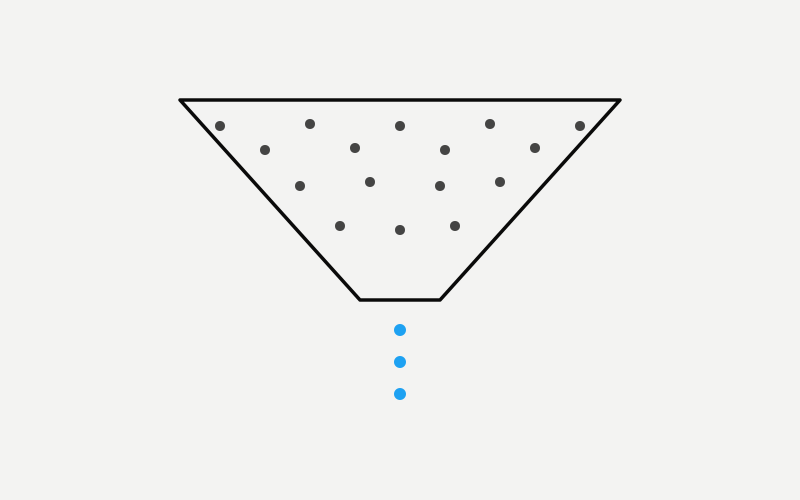
Benchmark inputs are filtered to be well-formed, in-distribution, and answerable, because that's what makes a benchmark useful for isolating the specific capability under study. That's a feature of good benchmark design, not a flaw — but it means the input distribution a technique was validated against and the input distribution it will actually face in production can be almost unrelated. Real usage is messy in ways a benchmark rarely captures: the wrong language mixed into an otherwise normal request, garbled formatting, a question that's secretly three unrelated questions stapled together, phrasing an annotator would never have written because no real person writes like an annotator.
A technique that gains several points on a clean benchmark can lose all of that edge, or turn net negative, against the noisy tail of real usage — and that tail isn't a small edge case to be handled later. For a live product, it's a meaningful share of total traffic, arriving from day one, with no benchmark curator standing between it and the model.
Picture a support-ticket triage system validated against a tidy dataset of well-written, single-issue tickets. The moment it meets real customers, it's parsing messages that bundle three unrelated complaints into one rambling paragraph, arrive in a language the evaluation set never included, or reference a product that was renamed since the training data was collected. None of that is exotic. It's Tuesday. A benchmark built to isolate one capability was never trying to prepare a system for that, and holding the benchmark responsible for the gap misunderstands what the benchmark was for in the first place.
The Last Few Percent Is Where the Engineering Budget Actually Goes
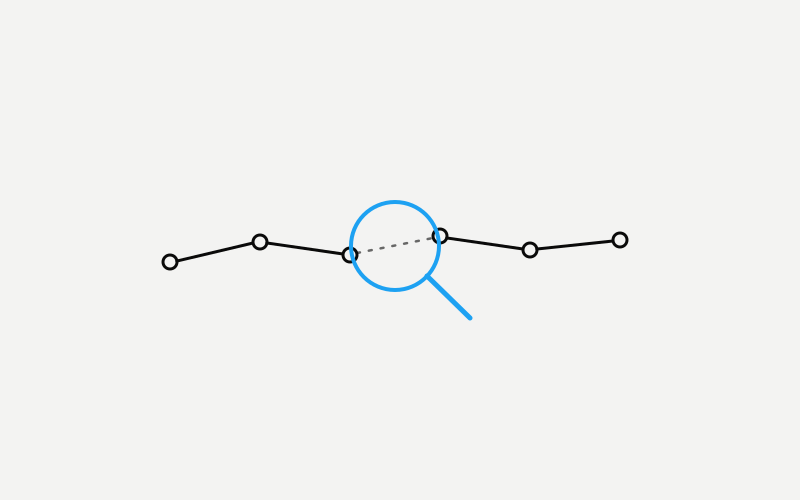
There's a version of this gap that has nothing to do with accuracy at all. A technique that's right nineteen times out of twenty can be a great paper and a genuinely dangerous product, because the interesting engineering question shifts entirely to what happens on the twentieth try. Does the system know when it's likely to be wrong? Does a confident, plausible-sounding failure get caught before a user acts on it, or does it just look like every other correct answer? Is there a fallback path, a human review queue, a monitoring signal that catches a quiet drift in failure rate before it becomes a pattern someone notices the hard way?
None of that shows up as a number in a paper, because a paper is measuring the capability, not the harness of guardrails, logging, fallback logic, and monitoring that has to surround the capability before anyone would trust it in production. In practice, that harness is often a larger and more expensive engineering effort than the original technique it's protecting, and it's almost entirely invisible from the outside — nobody writes a paper about their fallback logic, and nobody puts "we built extensive monitoring" in a product launch announcement, even though it's frequently the majority of what actually got built.
Publishing and Maintaining Reward Different People
Academic and research-lab careers are built on being first and being novel. The reward structure points toward the next paper, the next result worth writing up, not toward the unglamorous work of hardening this one against a thousand edge cases nobody wrote a benchmark question for. A researcher who publishes something promising and moves on to the next project has, in a very real structural sense, already collected their reward before anyone finds out whether the result holds up under sustained, messy, real-world load.
A product team's incentives point almost the opposite direction. Their reward structure is uptime, cost per request, and not breaking things that already work for actual paying users — an instinct set that runs directly counter to "let's try the interesting new thing from a paper we read last month." Neither set of incentives is wrong for the job it's attached to. But they rarely belong to the same people, on the same team, reporting to the same manager, and that organizational gap is where a lot of good research quietly stalls.
Nobody Owns the Handoff
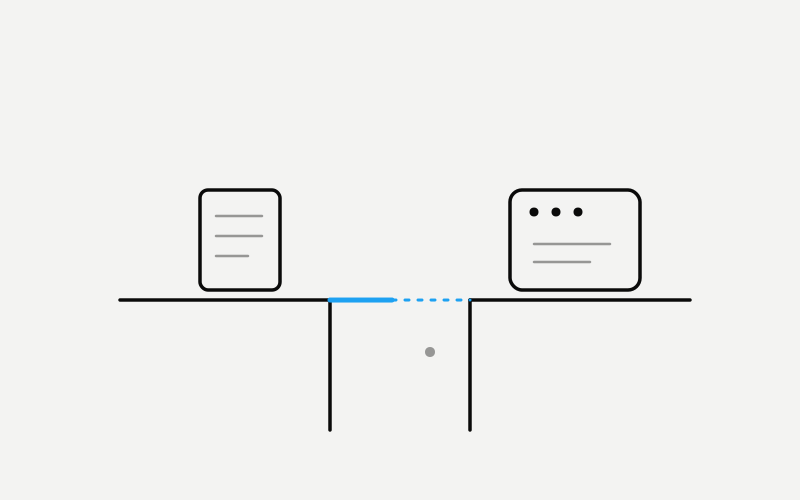
A paper doesn't automatically arrive on a product roadmap. Someone has to notice it. Someone has to advocate for it against a backlog already full of things known to work, with a known cost and a known payoff. Someone has to personally own the risk of a launch built on a technique validated in a research setting that looked nothing like production traffic. In most organizations, that someone doesn't have a job title, a budget line, or a performance review tied to making the connection happen.
So promising research tends to sit exactly where it was published — cited approvingly, referenced in the occasional roadmap discussion, implemented never — until either the original team productizes it themselves with a very different set of resources than they had as researchers, or a competitor's engineering team reinvents a rougher, more robust version of the same idea under real deadline pressure, usually without much credit flowing back to the paper that started it.
This is also why the organizations that reliably ship research tend to look different from the ones that merely produce a lot of it. The pattern isn't more papers or smarter researchers. It's a specific role, sometimes a whole team, whose entire job is translation: reading the research output, understanding what would actually need to change to make a given result production-safe, and staying accountable for that specific handoff instead of letting it fall between two departments that each assume it's the other one's job. Where that role exists, research has a path to shipping. Where it doesn't, the research pile just gets larger and the shipped-feature list stays about the same length regardless of how good the underlying papers were.
'Better Than Baseline' Is a Different Question From 'Worth Shipping'
A paper needs a defensible, statistically meaningful improvement over a comparable baseline to be publishable. A product needs that improvement to be large enough to justify the engineering cost, the added latency, the new failure modes it introduces, and the ongoing maintenance burden — weighed against literally everything else that team could spend the same quarter doing instead. A two-point benchmark gain can be a perfectly good paper and, at the same time, a genuinely poor use of a product team's next three months. Confusing those two bars, treating "the paper shows it works" as equivalent to "we should build this," is one of the most common and most avoidable ways promising research quietly goes nowhere.
That confusion runs in the other direction too: some ideas that would be transformative in production look unremarkable in a paper, because the paper is measuring the wrong thing for the question a product team actually cares about — reliability, cost, and graceful degradation rather than a marginal accuracy gain against a curated test set. A technique's publishability and its shippability are correlated, but only loosely, and treating them as the same measurement is how good engineering time gets spent chasing impressive charts instead of durable products.
None of this means the research was wasted, even when it never ships in anything resembling its original form. Unshipped work still reshapes what the next paper tries, what the next product team assumes is possible, what a competitor decides to build instead of what they read about. But if you're evaluating an AI capability by asking only whether there's a paper showing it works, you're answering a genuinely different question than the one that determines whether you'll ever actually get to use it. The more useful question, every time, is who is accountable for closing that gap, and whether anything about how they're incentivized suggests they actually will.