Key Takeaways
- A training run produces many candidate checkpoints, and the one that becomes 'the model' is chosen through internal evaluation, not automatically promoted by default.
- Released models pass through separate capability and safety evaluation gates, and a strong capability checkpoint can still be delayed by what red-teaming finds.
- The model behind a public API endpoint keeps changing after launch, through system prompt tweaks, guardrail updates, and re-optimized serving versions, even when its public name stays the same.
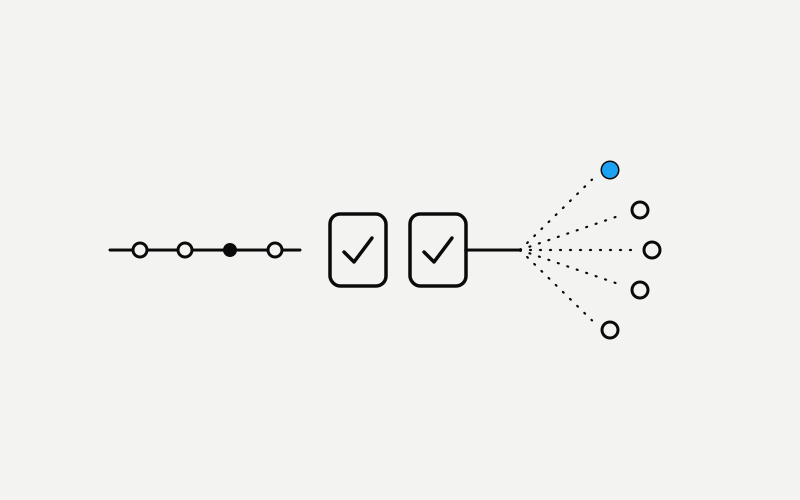
By the time you type a prompt into a newly released model, that model has already lived an entire life you never saw. It was one candidate among many checkpoints pulled from a training run, promoted past internal capability gates, pushed through safety testing, quietly adjusted after red-teamers found ways to break it, and rolled out first to a small group of people who were never going to write about it publicly. The version you are using on launch day is not the finish line of that process. It is a snapshot of it, taken at the moment the lab decided the story was good enough to tell.
We think understanding that pipeline is one of the more useful habits a reader of AI news can build, because it changes how you read a release. It explains why two labs can ship models a month apart that feel like they came from different eras of engineering discipline, why some releases arrive with a long safety report and others with barely a paragraph, and why the model you use in October can behave differently from the one reviewers tested in August even though the version number never changed. None of this is a conspiracy. It is what happens when a research artifact has to become a product, and a product has to survive contact with millions of people trying to break it.
A Training Run Produces Candidates, Not a Release
A large training run does not produce one model, it produces a long sequence of checkpoints, saved at intervals as the run progresses. Somewhere in that sequence, a team has to decide which checkpoint actually becomes the release candidate, and that decision is itself a judgment call informed by internal evaluations, not something the training process hands over automatically. A checkpoint further along in training is not guaranteed to be the best one to ship. Teams sometimes find that an earlier checkpoint generalizes better, or that additional training past a certain point improved one capability while quietly degrading another, and the later checkpoint gets shelved in favor of the earlier one. What you eventually use has already survived an internal competition against versions of itself that never shipped.
Picking a winner also forces an uncomfortable definition problem: better at what? A checkpoint that scores highest on coding benchmarks might read as slightly more clinical in open conversation. One that is warmer and more agreeable in casual use might be more prone to caving under pressure during adversarial testing. Teams have to weigh these trade-offs against a strategy for what the model is supposed to be for, and that strategic judgment, more than any single benchmark, is what determines which checkpoint becomes the release candidate everyone eventually meets.
The Gates Nobody Sees: Capability and Safety Evaluation
Before a candidate checkpoint is allowed anywhere near a release announcement, it typically passes through two different kinds of evaluation gates. The first is capability evaluation: does this checkpoint actually perform better than its predecessor across a broad internal suite, not just the handful of benchmarks that end up in the marketing post. The second is safety evaluation, which is a different discipline entirely: red-teamers, sometimes internal and sometimes external, try to get the model to produce content or take actions the lab does not want it capable of, probe it for dangerous-capability thresholds in sensitive domains, and stress-test it against manipulation and jailbreak techniques that circulate widely once a model is public. A checkpoint can be a genuine capability leap and still get held back, delayed, or shipped with additional guardrails because of what the second gate found.
The composition of a safety evaluation matters more than outsiders tend to assume. Serious safety testing increasingly draws on specialists from outside a lab's own engineering staff, people with backgrounds in domains like biosecurity, cybersecurity, or disinformation, where a highly capable model could plausibly cause real harm if it turned out to be unusually good at the wrong kind of task. This kind of testing is slow by design, because finding a genuine dangerous capability is supposed to be hard, and a red team that clears a model in an afternoon has not done the same job as one that spends weeks seriously trying to break it. When a lab says a release was delayed for safety reasons, this is usually that process running long, not a euphemism for something else.
These two gates do not always agree with each other, and when they conflict, safety usually wins, at least at labs with functioning internal processes. It is entirely possible for a checkpoint to be the strongest the lab has ever produced on capability evaluations and still get sent back for another round of fine-tuning because a red team found a reliable way to extract dangerous information, or because bias testing turned up a pattern that would embarrass the company if it reached users at scale. The public post announcing eventual release rarely mentions how many rounds of this the checkpoint went through, because a launch announcement is not the place a lab wants to advertise the problems it found in its own product.
Why Almost Nothing Ships to Everyone at Once
Even after a checkpoint clears both gates, it rarely appears in front of every user simultaneously. Most labs stage the rollout: first to internal employees using it in their own daily work, then to a small group of trusted external testers under agreements that restrict what they can share publicly, then often to a limited research preview or waitlist, and only after that to general availability through the API and consumer product. Each stage exists to catch a different category of problem. Internal use surfaces workflow friction. Trusted testers surface edge cases across industries the lab does not have in-house. A capacity-limited preview lets infrastructure teams see real traffic patterns before betting the full user base on them. By the time a model reaches general availability, it has effectively been released several times already, just to audiences small enough that a mistake stays containable.
The staging also serves a purpose that has nothing to do with catching bugs: it lets a lab shape the narrative of its own launch. A limited research preview generates anticipation and a wave of early, mostly favorable coverage from people who opted in and are inclined to be generous. General availability, by contrast, meets an unfiltered audience with no particular reason to be forgiving. By the time the mass-market rollout happens, the lab has usually already fixed the most embarrassing issues the preview group found, which is one reason the conversation around a model often seems to soften between its research-preview buzz and its general-availability reality, rather than the other way around.
The Model Keeps Changing After You Start Using It
This is the part practitioners underestimate most: the model you call through an API on release day and the model behind that same endpoint six months later are frequently not identical, even when the public-facing name has not changed. Labs adjust system prompts to fix behavior patterns discovered after launch. They tune safety guardrails in response to misuse patterns that only show up at real-world scale, which no internal red team can fully anticipate before millions of people start using something. They sometimes swap in a more efficient, distilled, or quantized version of the same nominal model to manage serving cost, with performance that is close to but not exactly identical to what shipped on day one. An endpoint name is a contract about roughly what capability you should expect, not a promise that the weights behind it are frozen in place.
This has a practical consequence that is easy to miss: a bug report or a workaround you find in a forum from a model's launch week may simply no longer apply by the time you read it, because the underlying behavior has since been adjusted. It also means the opposite can happen, where a workflow that worked reliably for months breaks without warning, not because you changed anything, but because a guardrail update tuned for a completely unrelated safety concern happened to catch your use case as collateral. Treating an API-backed model as a fixed, versioned artifact you can pin and forget is one of the more common mistakes serious teams make when they move from experimentation into production.
Launch Day Is a Calendar Decision, Not Just a Readiness Decision
Even once a checkpoint has cleared every internal gate and finished its staged rollout, the date it becomes a public announcement is rarely chosen by the research and safety teams alone. Launch timing gets negotiated against a conference calendar, a competitor's rumored release window, the end of a fiscal quarter, or a moment when the news cycle has room for the story instead of being crowded out by someone else's announcement. A model that was technically ready in one month sometimes waits for a better week to be born into. This is not evidence that the readiness process is fake, it is evidence that a lab is a business as well as a research organization, and businesses time announcements the way any company times a product launch, with half an eye on the technical checklist and half an eye on the room it is walking into.
This is worth knowing because it resets expectations about why a release lands when it does. A model announced two weeks after a rival's splashy launch is not necessarily rushed out the door in response, and a model that slips its expected window by a month is not necessarily behind schedule on safety work, though both explanations get assumed constantly in the discourse that follows every release. Sometimes a slip really is a safety delay. Sometimes it is a scheduling conflict with an executive's travel calendar. The checkpoint-to-changelog pipeline has a technical spine, but the date stamped on the announcement is the one part of the whole process negotiated in a room that also has marketing, sales, and communications sitting at the table.
What This Means for How You Should Use a New Model
None of this is a reason to distrust every release or wait indefinitely before adopting something new. It is a reason to hold two facts at once: a release announcement marks the end of one process and the beginning of another, and the second process is the one that actually determines whether a model is good to build on.
The rough edges reviewers find in the first week are real, but so is the fact that a lab is often still actively tuning the exact edges people are complaining about. The model that a serious workflow gets built on top of six months from now may quietly be a better-behaved version of the one that launched, running under the same name, having gone through a release cycle nobody wrote a blog post about. The checkpoint-to-changelog pipeline does not end at general availability. It just gets quieter.