Key Takeaways
- Reporting from Neowin (syndicated by Chosun) and The Star describes a US review process that checks closed AI models before release, but doesn't extend the same pre-release check to open-weight models — a scope decision, not an oversight process covering AI models broadly. We think that distinction gets lost when the story gets compressed into a single headline about what the administration is or isn't reviewing.
- The likely reason a pre-release review is built around closed models is structural rather than necessarily political: a closed model ships through a single company-controlled door, which a regulator can gate, while an open-weight model has no equivalent single release event once its weights are public, since the same weights can be redistributed and refined indefinitely by parties uninvolved in the original release. That mechanical difference means applying the same review tool to both categories wouldn't produce equivalent protection even if the administration wanted it to.
- We don't have the administration's stated rationale for excluding open-weight models, so we can't say whether this is a deliberate carve-out or a review mechanism simply built around the only lever that exists for closed models — and we think the honest answer right now is that the available facts support both readings. What would actually resolve the ambiguity is a stated rationale from the administration or evidence of a separate mechanism aimed at post-release monitoring of open-weight derivatives, neither of which has surfaced yet.
Reporting from Neowin, syndicated by the Korean outlet Chosun, says the process the US government is standing up to review new AI models for safety reportedly excludes open-weight models from its scope. Related coverage from The Star in Malaysia framed the same story more specifically: the Trump administration is set up to review "closed" AI models before they ship, not AI models generally. That's a narrower claim than "the US is reviewing AI models for safety" would suggest, and the gap between those two framings is worth sitting with before anyone calls it a loophole.
This surfaced in the same general news window as two other AI-policy stories we've covered separately — a voluntary White House AI safety framework and a round of state attorneys general pushing AI companies for more. We're not folding those into this piece; they're context, not the subject here. What we want to look at is narrower, and we think more useful than the "administration lets open models off the hook" read this detail is already generating: why would a safety review process be built around one category of model and not the other in the first place?
What the Review Actually Covers
Start with what's actually been reported, because it's easy to round this up into something bigger than it is. The mechanism described in this coverage is a pre-release check — a step that happens before a model ships, gating whether the company behind it can put it out into the world at all. The Star's phrasing is the more precise one of the two: the administration is set up to review closed models before release. Not AI models in general. Closed ones, specifically, ahead of their release.
We don't have the administration's stated rationale for that scope, if one exists — it isn't in the reporting we've seen, so we're not going to invent one here. What we do have is the structural shape of the thing: a review keyed to a release event, applied to the category of model that actually has a release event to gate. That's worth taking seriously as a candidate explanation before reaching for a more cynical one, and it's also worth not accepting uncritically just because it's the more charitable read.
The Choke Point Closed Models Have and Open Weights Don't
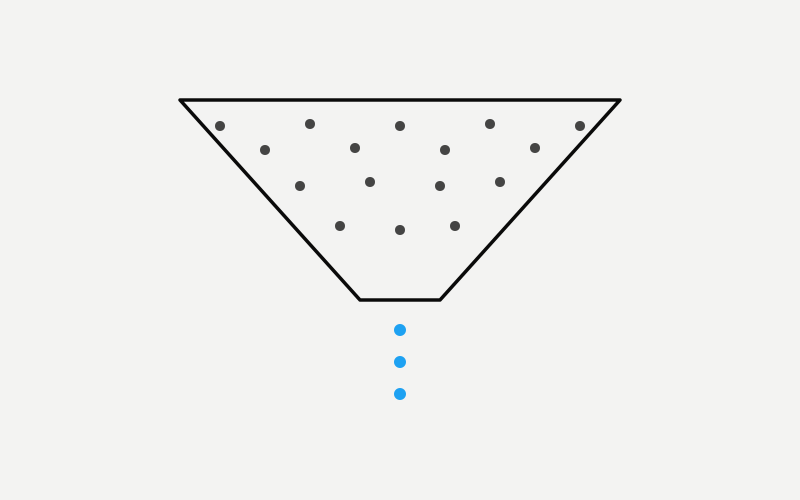
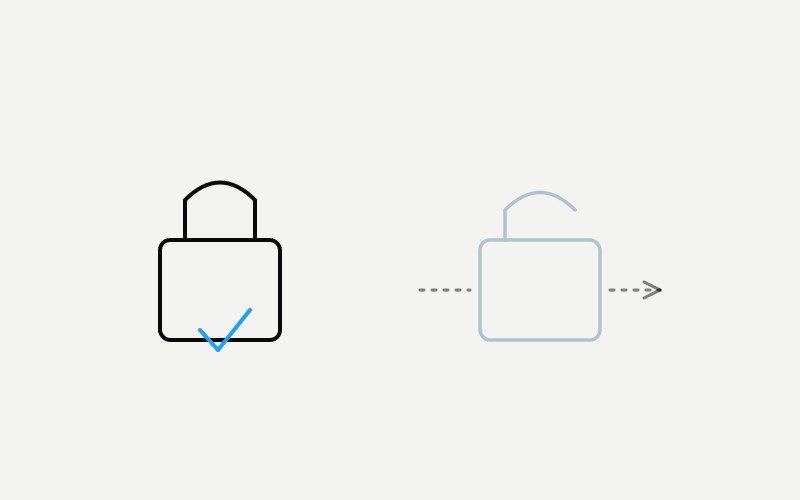
Here's the mechanism we think is doing the real work in this story, even though it isn't spelled out anywhere in the coverage we have. A closed model — something served through an API, gated behind a company's own infrastructure — has exactly one door it goes out through, and the company that built it controls that door. A regulator can tell that company not to open the door until a review has happened, and that instruction is enforceable in a direct, practical way, because there's nowhere else for the model to go. It ships through the company's servers, or it doesn't ship at all.
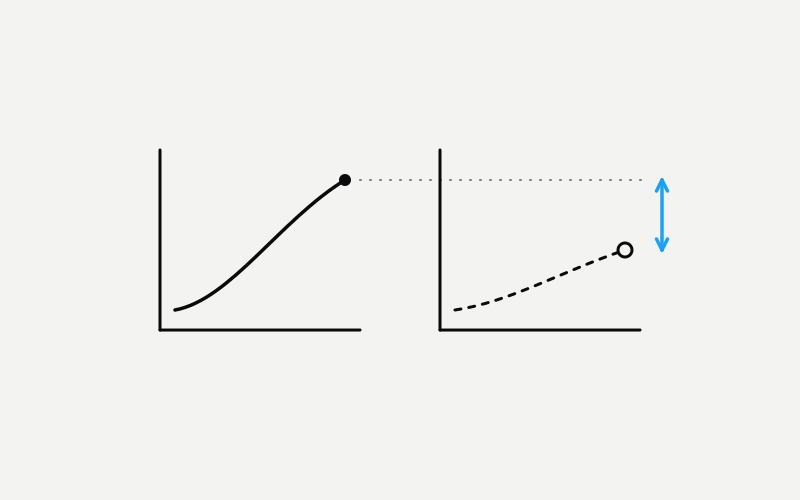
Open-weight models don't have that door. Once the weights are published, there's no single release event left to gate — there was, at most, one moment, maybe a later checkpoint release, and after that the same weights can be downloaded, fine-tuned, merged with other models, redistributed under a different name, and redeployed indefinitely by people who had nothing to do with the original release. A pre-release review aimed at an open-weight model can only ever review the version it can see at the moment of publication. It has no mechanism for the hundred downstream forks that show up six months later, running on infrastructure the original developer doesn't control and may never even learn about.
This isn't a new pattern in how regulation tends to attach itself to technology. Rules generally end up targeting whichever actor in a system can actually be compelled to comply, and that's usually whoever runs the centralized infrastructure, not the underlying technology itself. Content moderation rules attach to platforms rather than to file formats for the same reason — a platform can be told to take something down or hold something back, and a file format can't. A closed AI lab is the platform in this analogy. Open weights, once released, are closer to the file format: technically identical wherever they end up, but with no single operator left to instruct.
Two Ways to Read the Same Gap
This is the point where we think the story splits into two genuinely different readings, and we want to be upfront that we can't tell you which one is correct based on what's been reported so far.
If you start from the assumption that the administration is inclined to go easier on open-weight developers than on closed labs — for competitive reasons, ideological ones, or plain lobbying — this detail reads as confirmation. Closed labs get scrutiny, open developers get a pass, and the review's own scope is the evidence. That's not an unreasonable prior for anyone who's been tracking how differently "open" and "closed" get talked about in AI policy circles right now; open development carries real political currency as the more transparent, more democratized, less corporate-controlled version of the technology, and a policy that happens to treat it more gently fits a story plenty of people already believe.
If you start from the assumption that a review mechanism can only act on what it can structurally reach, the same fact reads completely differently. Of course the review is scoped to closed models — closed models are the only ones where "review before release" is a coherent instruction to give in the first place. Applying the identical review to open-weight models wouldn't produce equivalent protection even if the administration wanted it to; it would just check the initial publish while doing nothing about everything that happens to those weights afterward, which is arguably where most of an open-weight model's actual risk profile lives. Under this reading, the exclusion isn't leniency. It's an admission that this particular tool doesn't fit this particular target, and on its own it doesn't tell us much about the administration's broader stance on open-weight risk.
Both of those readings assume the administration thought carefully about open-weight models at all when it scoped this review, and that assumption might be doing more work than it deserves. There's a third, more mundane possibility worth naming alongside the other two: the review may simply have been built around whichever labs were already the ones in the room. Closed frontier developers are the companies government agencies have existing channels with, existing points of contact, existing precedent for this kind of pre-release engagement. A review scoped to closed models might reflect that practical starting point more than any considered judgment, deliberate or structural, about open weights specifically. We don't have evidence for that reading either. It's just a reminder that not every policy gap traces back to a decision about the thing that's missing.
What Oversight of Open Weights Would Even Look Like
It's worth pushing on the structural reading a little further, because "this tool doesn't fit" is not the same claim as "no tool would fit." If pre-release review is the wrong shape for open-weight models, the right shape is presumably something else entirely — monitoring of derivative models and fine-tunes after they've been released, obligations placed on the platforms that host and distribute weights, requirements that travel with a model card rather than with a single company's release decision, or some combination of the three. None of that is what this reporting describes, and nothing in the facts available to us suggests a parallel open-weight mechanism is coming alongside this review.
None of those alternative mechanisms would be simple to stand up, either. Monitoring derivative fine-tunes at scale is a different kind of institutional job than reviewing a fixed, countable number of pre-release submissions from a handful of frontier labs — it looks more like ongoing enforcement than a review board, and it raises its own hard questions about who's actually responsible for a fine-tune three or four steps removed from the original release. That's not a reason to wave off the exclusion as fine, actually. It's a reason the absence of a companion mechanism might reflect genuine difficulty as much as indifference, and we'd want to know which before assuming the worse explanation.
That absence still matters for how much confidence we'd place in the structural-limitation reading. A structural limitation is a considerably more sympathetic explanation when it's paired with a visible effort to solve the same problem a different way. A structural limitation with no companion mechanism anywhere in sight starts to look, at minimum, like an incomplete policy — even if it was never intended as a deliberate carve-out for open-weight developers.
What Would Actually Tell Us Which Reading Is Right
We don't think this is a case where more analysis on our end gets us to a confident answer, and we'd rather say that plainly than manufacture a conclusion the reporting doesn't actually support. What we'd need is more from the administration itself: a stated rationale for the scope decision, in either direction, would resolve most of the ambiguity here on its own. So would the presence or absence of any parallel effort aimed at open-weight risk specifically — monitoring, distribution requirements, anything at all — showing up in the months after this review process rolls out.
Short of that, we'd watch two things. First, whether this scope decision gets defended or clarified once it draws attention, because silence in the face of a "loophole" framing tends to let that framing calcify by default, whether or not it's accurate. Second, whether any future version of this review, or a separate process entirely, attempts to define what oversight of an already-released open-weight model would even mean. Until one of those things happens, we'd hold both readings open rather than pick one — the fact pattern we have genuinely supports either interpretation, and we think pretending otherwise would be the less honest piece to publish.